Vibe Analysis: Exploring LLM Adoption by Data Visualization Practitioners
Abstract
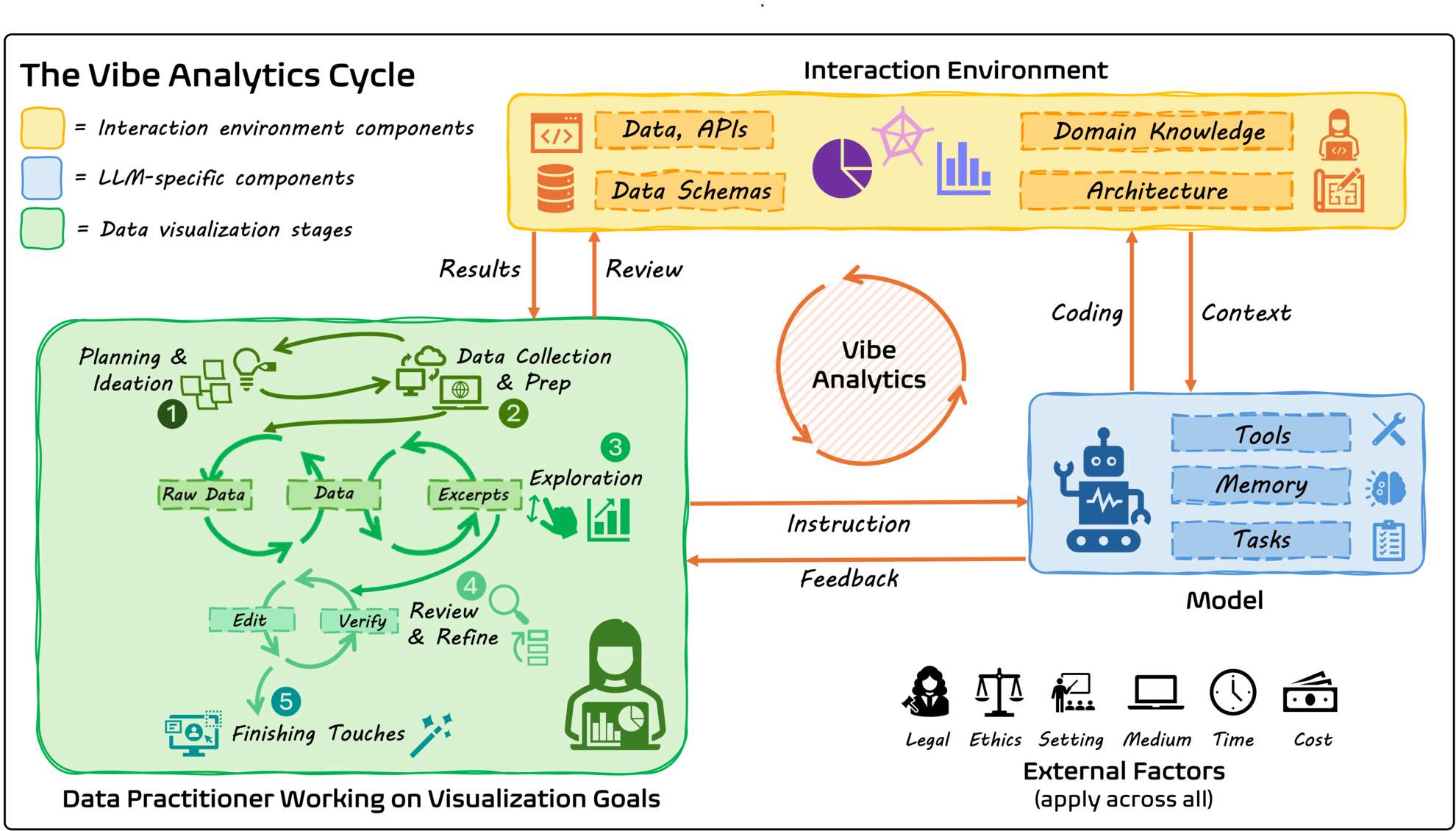
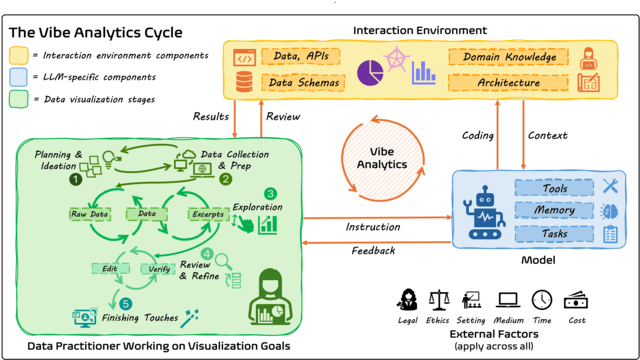
Large language models (LLMs) are enticing in their promise to support data visualization (Vis) through faster and simpler workflows for data prep, analysis, and visualization creation. Yet LLMs are notoriously error-prone and not built for data visualization tasks. Few studies have explored LLM adoption among Vis practitioners. To fill this gap, we conducted semi-structured interviews with members of the Data Visualization Society, a global community of data visualization designers. Our findings show that Vis designers actively use LLMs for both creative and technical aspects of the visualization process. A new visualization workflow is emerging, a process we call vibe analysis, analogous to vibe coding. Some key challenges raised by participants parallel those of vibe coding, while others are Vis-specific, like gaps in Vis knowledge and chart verification. This work opens up opportunities for research combining LLM-mediated work with Vis tools that incorporate data visualization guidance, constraints, and best practices.
Authors



Citation
Vibe Analysis: Exploring LLM Adoption by Data Visualization Practitioners
Shani C. Spivak, Aditi Krishna, Mahsan Nourani, and Melanie Tory. IEEE Computer Graphics and Applications—CGA. 2026. DOI: 10.1109/MCG.2026.3738283
Khoury Vis Lab — Northeastern University
* West Village H, Room 302, 440 Huntington Ave, Boston, MA 02115, USA
* 100 Fore Street, Portland, ME 04101, USA
* Carnegie Hall, 201, 5000 MacArthur Blvd, Oakland, CA 94613, USA